
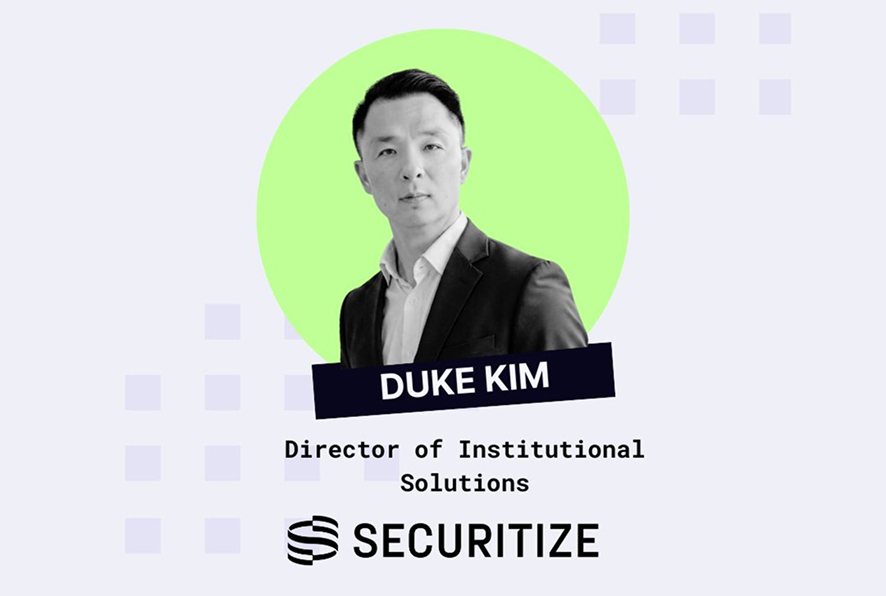
Duke Kim from Securitize on Real World Assets Tokenization
What We Discuss With Duke Kim
Securitize’s mission is to tokenize the world. With over $4 billion in AUM, they're the global leader in real-world asset tokenization, and their client list speaks for itself: BlackRock, Apollo, Hamilton Lane, and VanEck.
Now they've partnered with the New York Stock Exchange to tokenize stocks.
In this episode, I sit down with Duke Kim, Director of Institutional Solutions at Securitize Fund Services, to unpack what it actually means to put real-world assets onchain, why institutions are leaning in, and what the tokenization of stocks through the NYSE could mean for the future of finance.

Shownotes
- (0:00) Coming Up
- (2:55) Duke’s origin story
- (7:48) Blackrock and tokenized funds
- (14:08) Feedback from asset managers
- (18:25) Securitize’s role in tokenization
- (21:29) $600m to $5bn AUM growth
- (24:54) Securitize Fund Services
- (29:52) Get 2 months for free with Request Finance
- (31:31) Tokenization of stocks with NYSE
- (38:58) Is tokenized security an ERC-20
- (39:34) Blockchains Securitize support
- (41:47) Tech stack for tokenized assets
- (48:19) Pricing source
- (50:00) Onchain vaults & Securitize
- (55:29) Trillion dollar opportunity for tokenization
- (59:24) Securitize IPO
- (01:01:24) Career opportunities at Securitize
- (01:02:30) Takeaways on tokenization
- (01:03:58) Favorite quote
[00:00:00] Duke Kim: So instead of Tesla shares sitting in your brokerage account at Fidelity and you can't really do too much with it, I can convert them into tokenized shares. Same rights, same governance, same economic interests because they're simply shares sitting in my Metamask wallet or my Exodus wallet. But now I can do something in DeFi with them, right.
[00:00:16] Duke Kim: I can borrow and lend more easily against those assets. So again, I can make more money with my money. I wanna use the tokenized version of that.
[00:00:24] Umar: Securitize's mission is to tokenize the world. With over $4billion in AUM, they're the world's leader in tokenizing real-world assets, working with BlackRock, Apollo, Hamilton Lane, and VanEck on fund structures, and more recently partnered with the New York Stock Exchange to tokenize stocks.
[00:00:44] Umar: My guest today is Duke Kim, Director of Institutional Solutions for Securitize Fund Services. Duke's focus is to represent Securitize platform solutions across fund administration, real-world assets tokenization, and transfer agents. And Duke has grown into a thought leader in real-world assets tokenization and is regularly invited as a speaker at crypto conferences such as the Digital Assets Yield Summit, Crypto Finance Forum, and Cayman Crypto Week.
[00:01:15] Umar: When a fund manager like BlackRock or Apollo comes to Securitize and says, "We want to tokenize our fund," what problem are you actually trying to solve?
[00:01:25] Duke Kim: My cheeky answer is that the first problem that it helps managers, traditional managers solve is...
[00:01:30] Umar: Welcome to The Accountant Quits podcast, where we help accounting and finance professionals learn how to manage a business using crypto.
[00:01:39] Umar: On this episode with Duke, we discuss tokenization through Securitize, the New York Stock Exchange partnership, the tech stack for tokenization, onchain vaults, and more.
[00:01:51] Umar: The Accountant Quits is the official podcast of the Onchain Finance Institute, the leading educational provider for finance teams using digital assets.
[00:02:01] Umar: Their programs, the Crypto Accounting Academy and Crypto Treasury Management Academy, focus on practical knowledge, including tools required to work with digital assets. Inside their platform, you can connect with peers working in web3, join focused chat groups, access job opportunities, and attend practical workshops on onchain finance.
[00:02:23] Umar: You can join the community for free by heading to Onchain Finance Institute. The link is also in the show notes. Now let's get into my conversation with Duke.
[00:02:39] Umar: Duke, welcome, and thanks for making the time to be here.
[00:02:44] Duke Kim: Umar, thank you so much for having me. It was a pleasure to finally meet to you, last month in New York during Digital Asset Summit and to continue on the relationship across, both companies here.
[00:02:53] Umar: It's a pleasure to have you here, Duke.
[00:02:55] Umar: Before we dive into Securitize and tokenization, I always like to start with the origin story of the guest.
[00:03:03] Umar: So you've been in the crypto industry since 2018, starting at Lukka, where Lukka, they provide crypto data to enterprises. Then you went on to Ledgible, a crypto subledger, followed by The Block. The Block is all about crypto news and research. And for the past year and a half, like I mentioned earlier, you've been at Securitize, sitting at what I'd argue is right now one of the most consequential intersections in finance, bringing traditional assets onchain.
[00:03:34] Umar: Can you walk us through that journey, and what was it about real-world assets tokenization that made you want to move to Securitize?
[00:03:43] Duke Kim: Absolutely. So, I always joke that it was really a series of misfortunate, you know, career missteps that, that got me here. But, my, my traditional background comes from Wall Street, so I was a derivatives trader, a corporate bond trader through the global financial crisis.
[00:03:57] Duke Kim: So I, I sat, you know, at the, the real forefront of capital markets, pre-crypto, right? At that time during, during the crisis is when Bitcoin was born, and that's when I started, you know, reading about it, thinking about it, trying to get my head wrapped around this asset that came out of electricity and compute, right?
[00:04:14] Duke Kim: And then it, it wasn't a corporate bond, it wasn't currency or, what, what is the thing? So it's always been in the back of my mind, when I was out on Wall Street. Post sell-side trading for a number of years, got into consulting. I was at Bloomberg for a number of years as a Relationship Manager, and that's when I really, when I, I think, stepped foot into Bloomberg, which is a great company, right?
[00:04:36] Duke Kim: Has done a lot of good for traditional finance. Takes care of their employees. Great place to work. At the same time, I remember walking into my first day, a friend of a friend, you know, I get introduced to, and he looks at me and he says, "Welcome aboard, Duke. This is the best place to be, especially for old Wall Street guys. They'll never fire you."
[00:04:56] Duke Kim: And I realized then that I have to leave because I was just too young to die there. And I was, I think my first startup, I was in my mid-30s when I, when I finally took that plunge, but I just realized I needed something that would teach me every day. You know, on Wall Street, you make good money, you make some great friends, a lot of good stories, but at the same time, you're not really learning, anything on a, on a day-to-day basis.
[00:05:21] Duke Kim: And then also you're really just one cog in a broader machine where you don't really have an impact on that industry, good or bad, you know, ideally. That was, you know, the impetus broadly for why I got into crypto was just that, wanted to learn, wanted to be at a place that was really making an impact somewhere in capital markets.
[00:05:39] Duke Kim: You know, this has been my entire career and, and I think crypto broadly before it became digital assets was that opportunity.
[00:05:47] Duke Kim: Specific to tokenization, when I was at Ledgible, this was kind of tokenization round one, right in the, in the early '20s. We were trying to sell the subledger, the, the tax software for platforms that were tokenizing assets.
[00:06:02] Duke Kim: So originally tokenization was something for me to sell into, and then on the back of that from a reporting perspective, and on the back of that, I really started to understand the unlock that tokenization offered, both from what I call front of house, right from an investor experience perspective.
[00:06:18] Duke Kim: So you have like many people that enjoy crypto and digital assets, right? You have the concepts of, of self-sovereignty, of not trusting an institution saying, "Umar, you have $100 in your Chase bank account." Well, now you have it in your wallet. You control that. No one else can take that from you. But also then from the back of house impacts as well, when you think about tokenized deposits, instantaneous final settlement.
[00:06:42] Duke Kim: So now you have no worry of trade failure from like a DVP, RVP delivery versus receipt, you know, just trade flows, right? You have atomic swap settlement, no trade failure. You make it much more efficient and you ultimately unlock capital on bank balance sheets. They actually post the financial crisis.
[00:07:02] Duke Kim: All the major banks and brokers have to hold a tremendous amount of idle cash that does nothing, right? Just to support. We do a big trade, you forget the trade. I'm, I'm out money, I'm waiting for securities to be delivered. When you have tokenized assets that are, you know, uh, running on, on blockchain rails, all of those problems go away, and that capital can also be unlocked for the banks.
[00:07:26] Duke Kim: So there's again, both a, a back of house tremendous capital unlock and also a front of house investor benefit to tokenized assets. And the two combined, you know, leverage on my background and my experience, but also because the space moves so quickly and there's so many people innovating, really gave me an opportunity to both learn and also have an impact on the space.
[00:07:46] Umar: Thanks for sharing. Now, like I mentioned in the intro, Securitize, you guys provide the infrastructure for tokenizing financial assets onchain, covering the full life cycle from issuance and trading to compliance. Securitize currently has $4.5 billion in tokenized assets working with institutions like BlackRock, VanEck, and Apollo.
[00:08:09] Umar: BlackRock's BUIDL alone is the largest tokenized treasury fund in the world right now, with over $2 billion in AUM. So in short, Securitize, for the listeners, it's a regulated infrastructure that lets the world's biggest asset managers bring their products onto blockchain, right? Now, I wanna start with the business case of this.
[00:08:30] Umar: When a fund manager like BlackRock or Apollo comes to Securitize and says, "We want to tokenize our fund," what problem are you actually trying to solve? And maybe if you can walk us through what Securitize will then do in practice to make that happen.
[00:08:46] Duke Kim: Sure. Great question, Umar. My cheeky answer is that the first problem that it helps managers, traditional managers solve is really maintaining relevance, right?
[00:08:55] Duke Kim: As more and more, younger gen... You know, we talk about it here in the States, right? This multi-trillion dollar silver tsunami, this, this great wealth transfer. There are more investors that are really operating onchain, right? Again, if you are you know, significantly younger than me, you also have just more inherent distrust of, of the man, of the machine, right?
[00:09:16] Duke Kim: You, you've seen these big problems through the financial crisis of we, we thought we were entrusting our, our money, our retirement into this thing, and because of, rehypothecation, because of malfeasance, all these other problems that have occurred, right? These younger and younger investors are, you know, wanna hold their own assets, right?
[00:09:35] Duke Kim: Really control their own destiny, but also invest and think about risk management differently. You've, you've fast-forward a bit to COVID, and the WallStreetBets era, right? Where a lot of people were against realizing, "I'm never gonna be able to retire or buy a home because I only make $45,000 a year," right?
[00:09:53] Duke Kim: These same salaries are what I got paid, you know, 25 years ago. They needed to maybe take some more risk, maybe think outside of the box when it comes to investing in the opportunities. So I think tokenization is, you know, a solution to, again, traditional managers thinking about how they appeal to younger generations.
[00:10:12] Duke Kim: When Franklin Templeton released BENJI originally, Ledgible was in the background as the reporting partner for them, right? And the concept from their team, in, in my words only, right, was that they needed a way to again, appeal to and attract younger investors and maintain, again, that, that sense of relevancy.
[00:10:30] Duke Kim: The other piece then, from what we have brought, like you said, we are a fully regulated capital markets infrastructure for managers that want to come onchain. You know, as I talk to, new managers that are fast follows behind BlackRock, you know, again, the, the cheeky answer is we've already survived diligence by some of the largest issuers, custodians in the marketplace.
[00:10:51] Duke Kim: I can survive yours. Like, we will survive yours. We have all of that put in place now, and we're doing that at 4.5billion is, is a big number, but in the grand scheme of things, when you talk about total equity markets, total real estate markets, right, it's still a very large scale proof of concept conversation. So very early innings, right?
[00:11:12] Duke Kim: But when you think about where the size of some of our products have gotten to, I think where we sit, we have launched over the last seven or eight years about 30-ish tokenized products with great managers, and we'll call it, you know, pretty strong managers as well, just not obviously controlling the same amount of capital that someone like BlackRock does.
[00:11:33] Duke Kim: But seven or eight of those products are over $100 million in AUM.
[00:11:37] Duke Kim: Again, small when you think of the, the overall size of that manager, but at 100 to $200 million in AUM, the proof of concept experiment starts paying for itself, right? You're covering the, the cost of tokenization, the cost of updating operational workflows, going through the diligence process to onboard us as your vendor, right?
[00:11:58] Duke Kim: So we have now, again, proof of concept or, or really first product launches with these managers that can pay for itself. And I think that's also important when, people think about bringing this business case to the rest of management, right? So we have a number of conversations in flight now with leading issuers globally.
[00:12:18] Duke Kim: They're trying to obviously understand what, what is the thing, right? What are the regulatory risks? What are the things that we're not considering from a risk and control framework perspective? We love answering all those questions. And then we can also say, "Look, if this thing is successful," and we obviously want it to be successful, we have distribution, we have registered representatives that can sell tokenized fund products.
[00:12:40] Duke Kim: We have an incredibly active DeFi team that really helps drive utility for these security tokens, right? Going out to protocols and lending platforms and saying, "Hey Umar and I are about to bring XYZ type of product. This is the yield profile. This is the underlying. Would you think you have market makers or lenders against those assets?" Right?
[00:13:01] Duke Kim: So we really try to solve or at least have answers for the demand side of the equation, and then obviously the supply side of the equation comes from working with really, really great managers. The thing that it doesn't solve is, is maybe a better question. So when we think of all the would-be emerging managers, I have this crazy idea and I wanna tokenize it because I think it solves distribution. My, my thought is always that if you can't find money from your rich dentist next door offchain, you're not gonna find a lot of capital onchain, right? Thinking back to the NFT boom in the early '20s, my, my CPA had actually reached out. He's an amateur photographer. He's like, "Hey, Duke, I know you're really big in the NFT space.
[00:13:45] Duke Kim: You're, you know, you seems like you're having a lot of fun. You're making some money. You're trading all these, you know, monkey JPEGs. I have all these great pictures on my iPhone. I would love to make NFTs and, you know, make money off the thing." I told him, "Well, if you can't sell them on Etsy or some art platform, you're not gonna sell them on OpenSea."
[00:14:03] Duke Kim: Like, there is not gonna be... the on-chain investor is really just a subset of the off-chain investor.
[00:14:08] Umar: And like on paper, because they're now sitting on the blockchain, they're supposed to be faster, cheaper, more portable, programmable. But what's like the, the feedback that you've received from these asset managers that have dabbled into tokenized funds, asset managers and maybe investors as well?
[00:14:29] Duke Kim: Yeah. So going back to the, the initial the way I had opened it with a, a front of house, back of house kind of bifurcation, right? I think Securitize and, and, you know, the tier one tokenization platforms that compete alongside of us have created some of the solution for front of house benefits, right?
[00:14:47] Duke Kim: Again, adding utility to the security token, again, migrating what we'll call them traditional capital markets workflow, or you know, primitives, right? So borrowing and lending, right? So when you think of even folks like, if you have a Fidelity account and you have your 401k or your brokerage sitting there, you can borrow against those assets.
[00:15:08] Duke Kim: You can offer them out for lending. It's a complicated workflow. You gotta click a lot of buttons. A lot of people don't realize this. I was sitting in on a panel with the team from Robinhood during Digital Asset Summit, and they started talking about, again, the use case for being able to easily, more easily allow their investors to lend against their assets or to borrow against their assets, right?
[00:15:30] Duke Kim: That's what DeFi unlocks for tokenized assets. So when you have tokenized money market fund, tokenized private credit from Apollo, right, the concept is looping, which is just a fancy term for prime brokerage onchain, right. You have an invested asset that you have put capital into. You can now borrow against that asset to reinvest back into that product or, or do something else with it much more easily, still compliantly in, in the way we build the world.
[00:15:57] Duke Kim: You have that, that front of house use case to make, to allow investors to make money with their money, right? That, that's not just reserved for the ultra-wealthy that have, you know, $100 million in their brokerage account or $10 million in their brokerage account. You can do this with 1,000, right? Just through the magic of DeFi makes that easier.
[00:16:14] Duke Kim: Where I think we're all still trying to build and support is a lot of those back of house benefits. I was talking to a pretty large real estate group the other week, and, and again, they were very quickly starting to just go through how much money can we make off the thing? Where can we save money in this thing?
[00:16:32] Duke Kim: Said, "Well, here's where you can make money from by driving AUM, because those tokenized assets versus kind of the, the paper analogs are more easily used in DeFi. They should be more attractive to the investor, and so that'll drive AUM there, and which ultimately drives fees and performance and all that stuff."
[00:16:50] Duke Kim: The back of house questions were rapid fire to me. It's like, you know, what, what can we get rid of if we have a tokenized asset? Do we need fund administration? Do we need, you know, capital statements being sent over email? That stuff is still being fleshed out. You still need a fund administrator. You still need an auditor.
[00:17:07] Duke Kim: You still need a formation attorney. You still need valuation experts if you're dealing with illiquid level two, level three assets. You, you still need all of that infrastructure because at the end of the day, we're still living in mostly a paper world, right? You're still living in an analog world for capital markets.
[00:17:22] Duke Kim: You still need all those things. So that's still being fleshed out. Again, at the end of last year, there was a, a really big conversation, a couple of major banks and, and providers had started working on tokenized deposits, right? And, and again, that concept when you have tokenized deposits running on blockchain rails, you start unlocking at an institutional level, capital efficiency because you're not worrying about settlement risk, right?
[00:17:48] Duke Kim: Ultimately, there will have to be a change where the banks can unlock some of that reserve capital so they can do other stuff, and so there's less of a cash drag on the balance sheet. That's still to be delivered, to be seen in terms of when we'll get those things. Where we are a little bit faster is in cap table management, right?
[00:18:06] Duke Kim: Because it's in a blockchain, it's more, it can be more transparent. Some things have sped up a little bit, right? Again, with, with trade settlement, OTC for digital assets, some of those things have also sped up. But I don't think the benefits are solidly quantifiable yet and, and really, you know, needle moving just yet.
[00:18:25] Umar: All right. Now, to summarize for the listeners, Securitize is the fund operator and tokenization infrastructure provider, while BlackRock, Apollo, VanEck, they are the investment managers, right?
[00:18:36] Umar: So I wanna ask you, what is it that Securitize does not do in this process?
[00:18:41] Duke Kim: Yeah. So great question, and we don't always have to be, the sub-advisors. So there are multiple flavors of tokenization still dealing with taking a security, making a digital asset security, but in terms of the, the flavor of tokenization underneath that, whether it's tokenizing a full master fund.
[00:18:57] Duke Kim: So BlackRock BUIDL, net new product from BlackRock, right? We've, we've tokenized the master. We've often done feeder fund tokenization that rolls into an existing paper master. That's the Apollo product as, as a great example, right? So the Apollo diversified credit product is, I think, 20 years of, of history, $1.5 billion in AUM.
[00:19:18] Duke Kim: About this time last year, we tokenized a feeder fund into that master fund, and that sits at about a, a 10th of AUM, so about $150 million. Again, the reason why investors may opt to subscribe or invest into the, the tokenized feeder is because investors can more easily borrow and lend against those assets in the world of DeFi, right?
[00:19:37] Duke Kim: So again, going back to the looping concept.
[00:19:39] Duke Kim: So broadly though, we try to mirror the, you know, the, the paper analog workflow, the capital markets primitives, moving them on DeFi, moving them on blockchain rails. The thing that is still amiss, and again, and, and you know, if I had my druthers and I ran Securitize and, you know, Carlos reported to me rather than the other way around, I would think custody, or I, I do think custody is the thing that we don't do yet and, and the thing that is missing.
[00:20:07] Duke Kim: So if you are thinking about tokenized equity or, or even tokenized fund shares, right? You go through our KYC/AML process if you're investing or subscribing via stablecoins or digital assets, right? We do all of the compliance checks on the wallet, on the transaction, all of the normal things that would be expected from a screening perspective.
[00:20:27] Duke Kim: At the end of that onboarding and subscription journey, though, the investor receives tokens instead of a claim that's held against DTC, again, you know, against assets that are in some segregate or omnibus account sitting in your brokerage. Not exactly sure how that flow works, right?
[00:20:43] Duke Kim: Someone else is holding your assets, right? And for the most part, that's fine. When you think about tokenized assets, you can work with a custodian like a, you know, a Coinbase Prime, Anchorage, BitGo, to hold these tokenized assets. Most of our investors we've seen actually prefer self-custody because it again, more more easily enables the DeFi use cases that we talked about.
[00:21:05] Duke Kim: So short story long, though, we don't have custody, right? And I think that is what is and maybe I think this is a, a follow-up question on your side, right? That it drives us to where the, the sort of analog breaks or where does the analogy break here? Right now the answer, the thing that we don't do is, is custody of investor assets
[00:21:27] Umar: Very clear. Now, I was looking at the AUM of Securitize on DeFiLlama, and I saw that number grew from 600 million in March of last year to 5 billion in May 2025. So for years, tokenization was talked about but not acted at scale. But what changed last year, and what actually convinced these traditional fund managers to make the move onchain?
[00:21:51] Duke Kim: I think the answer is BlackRock, right? So they, you know, candidly, again, in my perspective, altered the trajectory of Securitize themselves, right? They participated in the last round that we, that we had to raise or that we, that we raised, excuse me. And again, went through the diligence, survived the diligence.
[00:22:10] Duke Kim: They felt comfortable. There's actually a, a podcast clip floating around today, May 1st on X about BlackRock seeing something different in Securitize as a tokenization platform versus the others. And that was really about being compliance first, regulated first as our stance, right? So I always say we don't do cute, we do black and white, right?
[00:22:32] Duke Kim: We're dealing with securities, making digital asset securities, nothing more, nothing less. So when BlackRock went ahead and said, "We're going to work with Securitize, launch a net new fund, net new product in BUIDL and tokenize the whole thing," that I think was the shot across the bow for the rest of the industry to say, "Hey, we can go in as well."
[00:22:55] Duke Kim: The comment, and I forget which prospect I was talking to about this, and they were again, most people come in very curious about, "Explain the BlackRock relationship. How did that work? How does this work now? You know, what are we not asking you?" Like, "Please help us make the business case internally."
[00:23:11] Duke Kim: And the comment from this manager was, you know, BlackRock can afford to be early to the party because again, we've been around for seven years and only the last several years of Securitize's existence has been that hockey stick trajectory, right? We just started going parabolic on the back of things like BlackRock, then Apollo, then, you know, Hamilton Lane, et cetera.
[00:23:32] Duke Kim: So they went in, it gave everyone else comfort to say if, if they're willing to, and if, if Securitize has survived that diligence, right, they're, they're gonna survive our process as well. The other comment though was that BlackRock, because of its sheer size, can afford to be early to the party. The flip side of that though is they can afford to be early to the party, they are early to the party, they can also take over the party, right?
[00:23:57] Duke Kim: So, so that is, I think, the impetus for other managers to say, We can do it now, right? There is clearly a compliant regulated path forward to do this, and we should, if we want to maintain, again, relevance with investors, but also competitiveness with large institutional asset managers, right? So across my inbox, my colleagues' inboxes that deal with managers and issuers of, of product, right?
[00:24:24] Duke Kim: They all want to be fast follows. This space, much like every other space, there is always that concern. This is a really great idea. We really love what you're doing. We're not sure if we wanna be your first customer. We already have our first customer. We have our first customer at $2.5 billion in AUM, which again, versus the rest of the world, still small, but compelling enough to really push other issuers forward.
[00:24:50] Duke Kim: So that, that's been the big driver and the big, you know, success factor for us.
[00:24:54] Umar: I wanna spend some more time on the fund admin side. So in April of last year, Securitize acquired MG Stover's fund admin business, making Securitize Fund Services, now the new entity, one of the world's largest, or the world's largest digital asset fund administrator, now servicing more than 30 billion in assets across 750 products.
[00:25:18] Umar: And I think that coincides around the time that BlackRock became a customer of, of Securitize. Can you walk us through what Securitize Fund Services actually does for its fund clients and how that MG Stover acquisition, I also know MG Stover, they built a crypto fund platform called Otto.
[00:25:37] Umar: How those built into the end-to-end service you now offer at SFS, which is Securitize Fund Services.
[00:25:45] Duke Kim: Absolutely. So when I think about fund administration and, and the way Securitize has been built, so it's really, you know, largely by acquisition, right? So we acquired a, a transfer agent. We used that to create and, and get approval for the digital transfer agent.
[00:26:00] Duke Kim: So the blockchain is the system of record, the source of truth, from a cap table perspective, right? From issuing security tokens, right? From issuing actual fund shares onchain. The original concept that Carlos had was that we needed to work with fund administrators that really understand the digital asset space.
[00:26:19] Duke Kim: So the first acquisition actually occurred at the end of 2024 with Theorem Fund Services, which was probably the second or third fund administrator launched in the late 20-teens. We'll call it smaller than MG Stover certainly, right? So we acquired Theorem Fund Services, launched Securitize Fund Services, then had the opportunity to acquire MG Stover shortly thereafter.
[00:26:40] Duke Kim: MG Stover launched in 2014, arguably the first digital asset-focused fund administrator, right? So as back in that day, right, it was Bitcoin only. So as funds and the concept of, of private funds were really being attached to, you know, crypto at the time of, of Bitcoin and Ethereum, right, we started seeing fund managers getting into this space.
[00:27:01] Duke Kim: So they have ideally some, you know, kind of traditional buy-side background, sell-side background. They get into this. Where that works inside of Securitize then going back to the concept of us being the only fully vertically integrated capital markets infrastructure, is that you, the manager, you, the emerging manager, needs all of the things that we offer, right?
[00:27:24] Duke Kim: Across ex fund formation. So you need a lawyer externally to build the documentation, right? We have fund administration, we have KYC/AML for investors, so investor onboarding, investor servicing. We have the transfer agent and the digital transfer agent that maintains, again, a record of who owns what, when, and where, right?
[00:27:44] Duke Kim: And then we have the DeFi team that, that sits, you know, inside, but really helps drive adoption and use of the tokenized assets. The critical sort of distinction or, or the, the piece that can be missed is that I don't want to tokenize every one of our fund managers, at least just yet, right?
[00:28:00] Duke Kim: A lot of products don't necessarily make sense from a tokenization perspective right now because there is not a DeFi use case for those funds. And I talked to Carlos about this, you know, his own venture fund is tokenized on our platform. It's not successful because it's tokenized. I tell every manager, "You will not be successful just because you have a tokenized fund offering."
[00:28:21] Duke Kim: Like, that in and of itself is not, the critical success factor, right? When an investor looks at the paper version of Apollo Private Credit and the, the tokenized version of Apollo Private Credit, the reason why they would want the tokenized version is because you can do stuff with it more easily than the paper version, right?
[00:28:40] Duke Kim: You can make more money with your money. And so the investors go through our process rather than just calling up their broker because they see that opportunity and they want to take advantage of that opportunity. So 200 managers, 700-plus fund strategies across liquid hedge to venture, PE (private equity), fund of funds.
[00:29:00] Duke Kim: Relatively speaking, that can be a standalone business, right? And that's what we do for a- all those fund managers and all those types of products that they offer. Slowly but surely, we will tokenize, you know, the players as they become you know, if we see a use case on chain.
[00:29:15] Duke Kim: And vice versa some of my pipeline comes in from existing managers that want us to administer the tokenized share class or the tokenized feeder fund, just because the workflows are more seamless because all the data is in the back end underneath the Securitize umbrella. And then again, it's confusing if you're a, a crypto native.
[00:29:33] Duke Kim: We're adding more utility to a security token because the data on the back end is more seamless and so you have, you know, intraday or same-day liquidity in and out of the tokenized product. All those things are, are much more easily accomplished when Securitize the umbrella is administering the fund and servicing the product.
[00:29:52] Umar: Before we continue, let's take a quick commercial break from our sponsor. If you're serious about running your business using crypto, you need tools built for crypto.
[00:30:03] Umar: One of my favorite apps, and yes, one that I use multiple times a month, is Request Finance. This app has been a game changer in how I invoice my clients and receive stablecoins and crypto directly in my wallet.
[00:30:17] Umar: But hey, there's so much more to it.
[00:30:19] Umar: Request Finance is the all-in-one platform for crypto operations, accounts payable, accounts receivable, expenses, and even accounting. Plus, they've got a killer multi-payee off-ramp to over a hundred and ninety countries, meaning you can pay someone with crypto and they get fiat in their bank account.
[00:30:40] Umar: Request Finance connects to over 20 blockchain networks, including Ethereum, Solana, Base, Arbitrum, Near and more.
[00:30:49] Umar: Here are some features that I love. Batch payments using your preferred wallet of choice, a single dashboard to track all invoices with real-time updates. All invoices contain the transaction hash for easy audits.
[00:31:06] Umar: But hey, don't take my word for it. Try it out for yourself. Head over to request.finance/partners/theaccountantquits and get two months for free with all the pro account features.
[00:31:19] Umar: Join 3,000 finance leaders today using Request Finance and make crypto operations simpler, compliant and less stressful.
[00:31:31] Umar: Now, I wanna go through a very exciting news that happened a few weeks ago only. So the New York Stock Exchange announced a memorandum of understanding with Securitize to collaborate on the infrastructure for making securities tokenized on public blockchain. So congrats on this huge announcement. But yeah, let's drill down, into the details a bit of this announcement.
[00:31:57] Umar: I'm gonna read what that announcement said. It named Securitize as the first digital transfer agent eligible to mint blockchain native securities for corporate and ETF issuers on the New York Stock Exchange upcoming digital trading platform. My first question is, what is actually a digital transfer agent?
[00:32:18] Umar: You did mention it in your previous answer, and what does that actually mean in practice for the securities traded on the New York Stock Exchange?
[00:32:28] Duke Kim: Sure. So I always like to caution, you know, tempering expectations, right? So the, the very specific wording that our press release mentioned, it's a MOU. So I say it's better than an announcement of an announcement, right?
[00:32:41] Duke Kim: If you're on crypto Twitter, there, there's, there's always this world of, "I'm about to say something really big, you know, tune in and, and watch next week," right? It's better than that, but we're obviously not in production, right? This thing is not live yet. And the, the NYSE is going to move, the, the biggest compliment I could give, you know, teams like that is they're moving as fast as they can, just given their size and their infrastructure and, and on some level, you know, corporate inertia as well.
[00:33:06] Duke Kim: What the MOU does state though, like you said, right? We are gonna be the first digital transfer agent as part of their, NYSE-affiliated digital trading platform for tokenized stock.
[00:33:18] Duke Kim: So first part, a transfer agent. Very traditional concept. I like to think of it as, you know, again, an analog oracle of, you know, who owns what, when, and where.
[00:33:28] Duke Kim: So it's really a cap table, right? So traditional TAs are the ones that say, "Umar has, you know, 100 shares of Nvidia as of May 1st." You know, a, a dividend is about to occur or there's a voting right. What, you know, the, that transfer agent is the one that records ownership and, really your, your physical address also to mail out statements or things of that nature, right? If they need to reach the underlying asset holder or the investor.
[00:33:54] Duke Kim: Digital TA is the exact same thing. We do operate one of the first, if not the first, digital transfer agent. It's SEC registered, approved, regulated, and the SEC, you know, says, "Okay, we approve this concept," And the concept being traditional TA operates on a Oracle database, SQL database, what have you, right?
[00:34:14] Duke Kim: Now we are leveraging public blockchains as the source of truth, right? So this, the, the actual public ledger says this wallet address tied to you, right? And that part is not public, right? Tied to, you know, Duke Kim, to Umar, et cetera, holds these assets as of this date and time.
[00:34:33] Duke Kim: The NYSE MOU and that announcement then says, "Hey, we are going to be the first digital TA to participate, to be connected to the NYSE trading platform."
[00:34:42] Duke Kim: So we are then also the design partner in the rest of these workflows. So when Securitize posted it off on their social channels, when I posted it on mine, right, there's obviously a lot of comments underneath that of just: What does it look like? You know, at the end of the day, how does it actually work?
[00:34:59] Duke Kim: To be honest, we're still figuring some of those things out, right? Which is the, the point of being a design partner. I think the, the kudos we can give to our team is that they chose us because, again, they've seen that we are compliance first, regulation first. We've done this with real asset managers at scale so, you know, we're, we're the best positioned to bring a really useful thing to market.
[00:35:24] Duke Kim: I think what's more powerful is the announcement or, what synergistically powerful, with the NYSE announcement is the announcement yesterday where we are partnered with ComputerShare, which is, I think, the largest transfer agent in the ecosystem supporting about 60% of the S&P500. So they are the traditional paper transfer agent for Apple, for Disney, for, you know, Nvidia and Tesla, right?
[00:35:50] Duke Kim: So when you have those two things combined, right, now you think about when providers and issuers think about tokenization of their securities, one of the concerns is: what do I have to replace from my existing infrastructure stack? Should I replace something from my existing infrastructure stack?
[00:36:09] Duke Kim: That announcement gives, I think those public equity issuers comfort and, and clarity in saying, "You don't have to rip up your contract with ComputerShare." There is, there's no, you know, change there. There's no risk of relationship there. We are simply partnered with ComputerShare to offer the digital version of those securities.
[00:36:29] Duke Kim: You don't have to rip and replace. It's actually complementary and you can offer both. The easy concept I think about it is let's say, and everyone is, again, this is neither public nor private information. Everyone's chasing after SpaceX for their IPO, right? Every, you know, digital asset exchange out there wants to be able to trade tokenized shares of, of SpaceX when that thing IPOs, right?
[00:36:53] Duke Kim: Let's say the IPO, the, the managers at the traditional investment banks are saying, "We're going to issue 100 million shares." Well, what you could do, and, and you can do this with an existing, you know, Tesla as as it exists now, right? Again, not replacing your traditional transfer agent, working together.
[00:37:11] Duke Kim: So we are the, the co-TA, the sub-TA for, for the entity and for the issuer. We identify with the issuer, 20 million shares that are sitting at DTC. We pull them out of circulation, right? So now the existing paper shares go from 100 million to 80 million, and then Securitize and the Securitize digital transfer agent will mint 20 million tokenized equity shares.
[00:37:35] Duke Kim: So net net, you still have 100 million shares running around. The two are completely fungible, right? They're both securities and investors can be able to jump back in, in and out of, of either version that they would like based on their whims or based on the use case, right? So I can, again, foresee a world in which we have worked with ComputerShare, worked with NYSE to again tokenize Tesla shares.
[00:37:58] Duke Kim: Great. So instead of Tesla shares sitting in your brokerage account at Fidelity and you can't really do too much with it, maybe these younger investors, these more forward-thinking investors say, well, I have all those shares sitting there and they do nothing for me. I can convert them into tokenized shares, same rights, same governance, same everything, right?
[00:38:17] Duke Kim: Same economic interest, because they're simply shares sitting in my Metamask wallet or my Exodus wallet, but now I can do something in DeFi with them, right? I can borrow and lend more easily against those assets. So again, I can make more money with my money. I want to use the tokenized version of that.
[00:38:33] Duke Kim: So I think that those two announcements in combination have a really powerful synergistic effect. Then, and I was writing about this on LinkedIn the other afternoon, right? Then you have the DeFi team alongside of us internal to Securitize, right, making sure that there are really great compliant places and compliant workflows that are implemented so that investors holding tokenized securities, tokenized equity can do more stuff with their stuff.
[00:38:58] Umar: I'm just trying to think, in terms of proving ownership of a tokenized security, under which token standard would that be? That's a ERC-20 token, right?
[00:39:07] Duke Kim: Correct. Everything from world starts, or the journey from, from us starts with an ERC-20. So it's very simple. The contract is, is pretty lightweight.
[00:39:17] Duke Kim: Our technical team has been building, you know, this DS protocol, their own vault infrastructure, things of that nature. So but it's meant to be pretty easy to understand, and it's meant to be pretty lightweight, for, for us as the, the tokenized the token issuer alongside the actual issuer.
[00:39:34] Umar: Now, at Securitize, you currently issue tokenized assets across multiple blockchains. BUIDL launched on Ethereum, Hamilton Lane Scope Fund expanded to Ethereum and Optimism as well, and you've been expanding to other chains like, I believe, Solana, for example. Which blockchains does Securitize currently support?
[00:39:55] Umar: And my question is this, like, who determines which chain this asset will be deployed on?
[00:40:01] Duke Kim: So, right. So again, everything starts as an ERC-20 on ETH, right? And then it's, it's really up to the manager. So philosophically, what we've really been building towards are, or, or building on are public blockchains, right?
[00:40:13] Duke Kim: That's part of our DNA. So again, internally, we have the conversations about Canton, we have the conversations about other, you know, permissioned or, or private blockchains or private permissioned blockchains, et cetera. We can, right. I don't think we've either seen the, the need or or built the business case internally or externally with, with an issuer that wants to be on those blockchains yet.
[00:40:36] Duke Kim: So not meant to be a tribal, you know, fight here on, on this pod, but where we have been, we support about, I think, a dozen and a half public blockchains, and we'll build to more just based on where we see activity. From where, you know, who decides what to deploy on, we leave that to the manager, right? So oftentimes they come to us and say, "Hey, where should we deploy?"
[00:40:58] Duke Kim: And we'll say, "Well, it's truly up to you," right? We are on some level a purely technical solution. We just give you the option. It's, it's basically just a menu when you onboard with us. Where do you want to deploy? You can certainly deploy on more blockchains, right? We have interoperability. We use Redstone and, and Wormhole, right?
[00:41:15] Duke Kim: We can do all those things with the assets. The question just comes down to operational control, operational risk, TVL on those chains. Does your product make sense on that chain, right? Is, is there going to be a natural buyer base on some of the, less trafficked L1s and L2s, right?
[00:41:34] Duke Kim: So, so again, not a, a value conversation, not, you know, not neither good nor bad, but simply we leave that up to the manager. We can certainly build the tech for it, and we'll build to, to what we need to build to.
[00:41:46] Umar: Got it. Next, I want to spend some time on the tech stack for these tokenized assets. So basically for the finance people listening to us, how do they actually manage tokenized securities, funds, or other RWAs on their balance sheet?
[00:42:02] Umar: You've spent time at Ledgible, a crypto subledger before joining Securitize, so you actually understand this problem from both sides. If equities and funds are now settling onchain 24/7, the infrastructure for accounting, of course, has to evolve with it. Does every company holding tokenized securities now need a crypto subledger in their stack the same way, you know, the web3 companies today use tools like Cryptio or TRES?
[00:42:31] Duke Kim: I think so, right? So when you think about even from a fund perspective and, and fund administration, I always joke, if you and I are just smashing a button on Coinbase, you may not need a digital asset focused fund administrator, and SFS, Securitize Fund Services, is really the only pure play digital asset focused fund admin out there.
[00:42:51] Duke Kim: You can probably, maybe, I wouldn't recommend it, but you can certainly go to a traditional administrator and they can take a CSV extract of our Coinbase activity and say, "We could administer, you know, do accounting, do all of the books and records on the back of that." As transaction volumes or complexity of the strategy increases, then I would make the, the strong argument that you do need a tool like a Cryptio or a TRES, right?
[00:43:18] Duke Kim: So that you have both traditional view, using general ledger platforms or ERP platforms. And we're really meant to be, we being the, the crypto subledger providers that are out there, the subledger, right? They're the sub GL, they're just the crypto version, or just the crypto activity aggregated, standardized, normalized, and then plugged into or rolled up into more traditional general ledger software.
[00:43:44] Duke Kim: So where we fit is from a tech provider perspective, certainly, but also just education of just understanding what all you're doing. So Securitize leverages a couple of tools like Cryptio, right? Securitize Fund Services uses different tools just because we are somewhat different businesses, different use case.
[00:44:02] Duke Kim: So we'll leverage tools like an Otto and TRES Finance for the crypto community because of the, the volume or the complexity of what some of these managers are doing. And there are certainly other tools as well that can also be leveraged by the fund manager themselves, acting at, like a a shadow ledger capability.
[00:44:20] Umar: All right. And is there any other tools that comes to mind in the tech stack of what those, let's say, institutional players now issuing their tokenized securities, funds would actually need? We mentioned custody before, so platforms like Fireblocks, Anchorage, BitGo. Does any other tool come to mind?
[00:44:42] Duke Kim: The only other one that comes to mind more from a trading perspective than it would be from an issuance perspective, 'cause from a issuance and valuation, I'm doing your NAVs, right?
[00:44:51] Duke Kim: So I'm giving you the actual compliant NAV calculation, the price for those you know, tokenized shares. When you are a fund trading in liquid assets or illiquids, I guess, as well, right? Then you also might think about GAAP and IFRS compliant pricing and data sources. So this has been a problem in the fund space for really since digital asset funds were a thing.
[00:45:14] Duke Kim: So when I think of reviewing PPMs and offering memorandums from the late 20-teens for my fund admin clients, everyone would simply say, "Well, we're just gonna use, you know, CoinMarketCap or CoinCap back," there was a I'm forgetting the name now. It was a ShapeShift product. And we'll just say, because the markets are 24/7, let's just use midnight UTC, and that's just the best price we can capture That was fine.
[00:45:41] Duke Kim: You know, it wasn't an amazing experience for anyone, but, but we've seen as the space has matured, I remember when Bitwise was really starting their petition for ETF product, right? So in the late 20-teens, they created the Bitwise Real 10. And so it was a very deep, I remember for some reason loving reading this 200-page PDF that they had presented in front of the, like, the SEC and the PCAOB to say, "This is how we are actually going to give you a true GAAP-aligned, you know, IFRS-aligned market price for digital assets."
[00:46:13] Duke Kim: So because, you know, Bitcoin trades on every digital asset exchange out there, what's the primary market, right? Because that's what the traditional Wall Street, traditional buy side requires. There isn't a primary market. It isn't Coinbase or Gemini or Kraken necessarily. So they built an infrastructure to weed out the, the bad exchanges, the bad data, the wash trading that were just, you know, exchanges trying to boost up their their optics and their, their metrics, created that.
[00:46:42] Duke Kim: When I was at Lukka, we built a product, and now there are a number of other providers out there that have defensible pricing mechanisms and sources, right? This S&P is in the game, right? Like, they have now a way to say at 4:00 p.m. or whenever, your documents say you need to close the books and strike an end-of-day price, you have a defensible calculation methodology to derive that price or, or to identify the primary market and give you that price at a close.
[00:47:12] Duke Kim: So I think for managers in particular, that can be an add-on or another thing to be aware of and, and, you know, to make sure that you address properly so that you do have, again, compliant pricing on your books. The other piece, and it's been a little while since I've thought about it, right, from an accounting perspective, was I, I think the right way to think about it is the repeal of SAB 121, where digital assets held on balance sheet were just liabilities, right?
[00:47:38] Duke Kim: So there were, in the late early '20s, concerns about issuers, about I mean, DATs couldn't have been a thing in the early '20s because all of the crypto that they accumulated on their balance sheet would be viewed as a liability rather than an asset, right? And, and, you know, or you have this thing on your balance sheet, but because there's not a clear way to value them, you know, you have a billion dollars of Bitcoin, but we'll only credit you from an asset perspective 900 million, right?
[00:48:07] Duke Kim: Or, or 850 million, whatever the, the haircut is. Now we have pricing tools and data tools that can allow the, the full, value and appreciation of those assets held on balance sheet.
[00:48:19] Umar: Yeah, that's a great point you mentioned because you do have to determine this active market where you have the greatest volume and level of activity where your crypto asset is basically, trading.
[00:48:31] Umar: And let's say with a tool like Otto, what pricing source would you use? Because I understand like subledgers, they are actually using sources like CoinMarketCap, CryptoCompare or CoinGecko.
[00:48:45] Duke Kim: So still depends on the manager themselves, right? In terms of their tolerance. I wouldn't even think about like from an operational risk, but If their investors and whatever their compliance requirements are such that CoinMarketCap is sufficient, then it's sufficient, right?
[00:49:01] Duke Kim: The, the subledger tools that, that we use that are out there in the market, they're really just data aggregators. So if the manager themselves says, "Hey, we really need to use digital asset research. We really need to use Kaiko for, for this thing or Amberdata," you know, whoever, no preference on our side.
[00:49:19] Duke Kim: It's a data source, right? Sometimes the conversation is who pays for that data source, right? Is it the administrator, the subledger tech? Is it the manager? But broadly speaking, it's just another data point and up to what the manager needs and what their documentation requires. So the tools that we use are pretty flexible there.
[00:49:35] Duke Kim: And then again, we just configure based on manager preference. Some managers are completely happy just saying, "Hey, we do a majority of our trading on Kraken. We'll use the, the Kraken price for XBT at 4:00 PM Eastern as our, as our snapshot." That, that's fine as well. So it's more about configuration. We're, you know, again, we are a tech provider at the end of the day.
[00:49:59] Umar: Yeah. Very clear. All right. So I wanna move on to another, a different topic now, which is onchain vaults. So these onchain vaults have become an increasingly popular way for institutions to earn yield onchain. I was looking at DeFiLlama, the TVL across risk curators is currently sitting around six billion right now.
[00:50:19] Umar: Last month, Securitize Fund Services, the fund admin arm that we just went through, they announced a partnership with Upshift, an institutional grade onchain yield platform to deliver independent audit-ready reporting infrastructure for onchain vaults. Can you walk us through Securitize involvement with onchain vaults, what that looks like in practice, and yeah, what this partnership with, Upshift actually means?
[00:50:47] Duke Kim: Sure. So I love vaults, right? This narrative has really taken a hold over the last six months, you know, in terms of a TVL perspective, like you had mentioned, right? A lot of traditional managers and digital asset managers are either deploying into these vaults or starting to curate and create them themselves, right?
[00:51:07] Duke Kim: You saw Bitwise actually launching onchain solutions, so one of the leading digital asset, you know, kind of traditional-looking managers, right? Also getting into this space in a very serious way. Apollo getting into this space in a very serious way. So the way I think of vaults broadly is onchain hedge fund, right?
[00:51:25] Duke Kim: It's a smart contract created to identify the best yield opportunity for the assets that it's been entrusted with, right? So it's a stablecoin pair, ETH and a stablecoin, whatever the things are, then that contract says, "I will go identify the best place to make money with your money," right? In a, in a secure, transparent way.
[00:51:43] Duke Kim: So the concept is fund managers that are my clients on the, the SFS side, right? They are also looking at curating vaults as another way for investor distribution, getting access to people, getting access to capital, right? And capturing fees on that, leveraging their strategies to, to make more money with your money, right?
[00:52:03] Duke Kim: They're also deploying as an LP into that vault as well. So the concept first was, "I just have to get in front and be able to support my client base." And then we took that a step farther in saying, "Well, if these vaults look like funds to some degree, then they might want independent reporting as well from a performance perspective," right?
[00:52:22] Duke Kim: So don't just trust the platform. You know, it's not a trust me bro situation, right? These are, these are dealing with real amounts of institutional capital. They may want external reporting done on that smart contract on that vault. You have some platforms that have built a little bit of really cool tech-- not even a little bit, sorry.
[00:52:41] Duke Kim: Built really cool tech when you think of something like Accountable, right? It's a, a vault curation platform, but it's also accountable, right? So that it can give you a portfolio level NAV, right? Which is really, you know, number of tokens that are, are locked or pledged in a vault times a price at, at a given moment in time, right?
[00:53:00] Duke Kim: So some platforms can give you block by block or every six seconds, right, visibility and a, and a price of risk. What it doesn't do, obviously, is give you fund level NAV or vault level NAV based on where the assets are at, at any given point in time. But they also don't output data that is audit and tax ready.
[00:53:20] Duke Kim: You know, one interesting thing that I've seen is the Big4 KPMG's tax team in New York, so the US KPMG team writing on LinkedIn, writing publicly about the tax implication of vault curation and vault liquidity provision, right? Still big questions out there, but they're getting ahead of that by throwing some of those questions out there and saying, "Here, these are the things that we all need to come to consensus on, come to agreement on how we're going to navigate the space."
[00:53:47] Duke Kim: So I said, well, now there is a real need for independent data in a format that is digestible by audit and tax professionals, right? It's not enough just to say 100 tokens are in this wallet, they're at this price. That- that's fine. That's important information, absolutely, right? That is not sufficient information to be audit and tax compliant.
[00:54:11] Duke Kim: So that's where we came up with the idea of going out to the vault platforms themselves and saying, "Hey, can we work together to provide you that extra layer of independence in reporting? But also that reporting is going to be very useful in helping you capture institutional capital and institutional allocator or institutional capital and institutional vault curators so that they can leverage your platform to receive institutional capital."
[00:54:38] Umar: And those reports would eventually be publicly viewable, right?
[00:54:43] Duke Kim: Some of them can be, right? When you think about the vault level reporting, absolutely, right. They, they should be reportable. So then it's simply us reading contract addresses, wallet addresses, doing the formatting, normalization, et cetera, and then being able to publish on, on some periodic basis back to that vault platform for, external revelation.
[00:55:02] Duke Kim: LP level, again, it's really all onchain. We're still figuring that out at the level that I'm in a vault, I'm participating in a vault. Should that information be fully publicly visible? And it, and again, it's really a reformating, formatting exercise more than anything. Like, you have my wallet address, you can see what I've done, but is it in a, a way that, you know, your tax person versus my tax person can use?
[00:55:27] Duke Kim: That, that's, to be determined.
[00:55:29] Umar: Duke, this conversation is fascinating, but, I'm seeing we're soon gonna be hitting the one-hour mark, and I wanna be respectful of your time. Maybe there's a last topic that I wanna go through, which is on the future of tokenized assets. Securitize slogan is to tokenize the world.
[00:55:47] Umar: Last month, you published a report with Keyrock. It's a 60-page report, I can share it in the shownotes, and it's titled The 400 Trillion Future of Tokenized Assets. The core thesis is that tokenization solved issuance. Every major asset class like T-bills, equities, private credit, funds now has a representation on a public blockchain.
[00:56:10] Umar: But the report makes an important distinction.
[00:56:13] Umar: Putting an asset onchain is not the same as making it trade, compose, and settle like a financial instrument, meaning the issuance era it delivered with Securitize in the driving seat, now the distribution is the next phase.
[00:56:29] Umar: As we close out today, where are we actually in this distribution era, and what still needs to happen in the infrastructure before, let's say, more institutional capital can come onchain?
[00:56:43] Duke Kim: It is the, yeah, multi-trillion dollar question, right? So we'd always say, look, if, if everything on our, on our side starts as an ERC-20, tokenization is, is relatively simple from that perspective, right? You and I can flip our phone open and, and tokenize whatever we want or create a token, right?
[00:57:00] Duke Kim: Whether or not it's compliant is a different question, but, you know, tokenization in and of itself is just the, the first domino to fill. Distribution is the challenge, but I think the roadblock to distribution, is, is twofold, right? So one, going back to the concept of custody, right? At the, at the issuer level, if they actually need to custody digital assets, do they get comfortable?
[00:57:20] Duke Kim: How do they get comfortable? What are the operational controls and paperwork they need to update to, to support those assets? From an investor perspective, same thing, right? You and I have probably an ungodly number of Metamask wallets across all of our computers, but most investors still don't, right? And you can't just call up your Fidelity broker and say, "I need you to custody or hold my, my digital token," right?
[00:57:44] Duke Kim: "My, my tokenized assets." Their, uh, you know, the retail level infrastructure is, is not there yet. I think that's, that's a piece of it. The other side then, there's this bit of a, a chicken and egg, and this is gonna go to a longer conversation, is just around the current onchain investor base with the current onchain tokenized assets, right?
[00:58:05] Duke Kim: So what we have built, what our, what our competitors have built and, and created so far, money market funds, AAA CLO product, low, no duration type product with corresponding, you know, yield profiles. As more investors come onchain and there's stickier capital, right, we can create higher yielding opportunities because higher yielding assets will come onchain and investors aren't always worried as soon as price goes down a little bit that I need to jump out, right?
[00:58:32] Duke Kim: If I were to jump into a private credit fund, I'd be more than happy with you know, quarterly redemption window and illiquidity because my capital is going to be stickier and I'm not here for, you know, a, a quick trade in two days. I, I wanna be here for, in this product for three years. So but those two are kind of the, the, the same problems together, right?
[00:58:51] Duke Kim: So it's, it's who's onchain, what's onchain, right? We need to kind of bring those together in lockstep. So distribution broadly, though, is that big challenge. We try to bring stuff that is going to be appealing to investors, so we work with the great managers. There's a specific yield profile. We identify with our DeFi and our ecosystem team the use cases for those assets, making them more useful.
[00:59:14] Duke Kim: Why does an investor want a tokenized versus a paper product, right? Putting all those together has, I think, been the, not even the secret to our success, it's the recipe to success.
[00:59:24] Umar: And I could also not finish the podcast without mentioning that Securitize will be going public, right, very soon. What does this change for or what does it mean for Securitize and, more broader, the tokenization industry?
[00:59:40] Duke Kim: Let me answer the, the second part first. I think it's a, it's a really great credibility point for all of us in this ecosystem, right?
[00:59:47] Duke Kim: Whenever these larger crypto companies go public, Coinbase, BitGo, us, it's a really, it's a great shot of legitimacy and credibility in the ecosystem. Everyone always jokes when, you know, your company goes public, your parents are like, "You work for Bitcoin, this is really neat. Like you're, you're doing something real now.
[01:00:04] Duke Kim: You work for a real company." So there's that part. I personally am a excited that we're being born in, in somewhat of a bear market here as well, right? The, the revenue multiples, the, the metrics are reasonable, right? We're not in the, that kind of DeFi bubble boom in the early '20s where everything was a, a unicorn with $10 million in revenue, right?
[01:00:27] Duke Kim: We have real revenue, reasonable metrics and, and multiples. Very excited.
[01:00:32] Duke Kim: Personally, I still have to work tomorrow, right? We, we go public, I'm still gonna you know, it's, it's a liquidity event, I still have to work. But on the flip side of that though, with the, the, I guess the, the SPAC funding and, and the pipe that we have, we'll have, I believe, 400 and...
[01:00:47] Duke Kim: And this is public, right? $460 million in, in cash, capital treasury, right? So that we can continue to build, we can withstand bear market turbulence.
[01:00:57] Duke Kim: We can acquire what we need to acquire if we need to acquire something to continue building what we really see as a tokenized future. So it's great for the ecosystem, obviously great for us, great for our team.
[01:01:10] Duke Kim: And there are people, you know, inside of the company that have been here day one, right? They have just poured blood, sweat, and tears into the company, into the platform, and we've all shared the same vision of tokenization of the world.
[01:01:24] Umar: Very exciting. I mean, it's a very exciting time to be a part of Securitize.
[01:01:28] Umar: And because this podcast is listened by accounting and finance professionals, are you guys hiring right now in the accounting and finance department, and maybe also remotely?
[01:01:38] Duke Kim: We are always hiring across Securitize Fund Services, right? So we are, again, you, you can view us as a standalone business, so there's always that kind of natural churn in the ecosystem.
[01:01:48] Duke Kim: So we're always looking. Specifically we have both a closed end, fund accountant, like a private equity fund accountant role open. There's always need for more liquid people as well. We are a remote company, largely US, and Canada domiciled, and so that's broadly where we've been trying to fish so far.
[01:02:05] Duke Kim: So if you are interested, please reach out to me. I'm very easy to find across, LinkedIn and X.
[01:02:11] Umar: Perfect. Thanks for sharing, Duke. Duke, this has been a fascinating conversation. As we close out the episode for today, has there been anything else that you wanted to mention to the listeners that we didn't, or how would you summarize the episode for today?
[01:02:27] Umar: The title was Tokenization of Real World Assets.
[01:02:30] Duke Kim: So I think the big takeaway is that regardless of where you sit as an audience member here, right, is that there are real companies building real infrastructure, regulated fashion, compliant fashion, working with real issuers, right?
[01:02:45] Duke Kim: So none of this now is, I think we've moved beyond proof of concept. We've moved beyond two guys in a garage with a dream, right? We're actually bringing this to light at scale, still broadly small across, you know, the, the, the actual market. But when you think about, I think Benchmark Securities had initiated research on our upcoming ticker and when we go public, and their comment was, "This team just getting 1% of the overall market tokenized dramatically shifts our profile."
[01:03:16] Duke Kim: And so I'm not here to, to pitch our stock or anything like that, but you really think about how much more game there is to play, right? And so us, some of our worthy competitors, people alongside of us in the ecosystem, really building to a future that is becoming more clear, right? Becoming a, a real thing and, and really starting to crystallize it's not just a pipe dream anymore.
[01:03:37] Duke Kim: Like it's, it's a thing that we can actually march towards. We have the, the path forward, and we have the, the TAM that has now been exposed for us to actually capture.
[01:03:45] Umar: Perfect. Thanks for sharing. I'm not sure if you saw this in the doc that I sent you as well, but there's actually a last question that I ask my guests before they leave is, do you have a favorite quote or like a maxim that you live by?
[01:03:58] Duke Kim: Lot of favorite quotes. The new maxim for me has been 30 minutes smarter. And the way I think about that, when I jumped into crypto, I always wanted to learn stuff, right? I, I really-- I didn't want to just smash buttons really quickly as a sell-side trader. I wanted to learn something every day.
[01:04:14] Duke Kim: So all the things that we covered today, some of those are in my actual day-to-day work. Some of those are just because I work for Securitize. Some of those are just because I'm in the DeFi ecosystem or broadly digital assets. I'm not a brilliant guy. I'm barely a smart guy, but I'm a guy that will spend 30 minutes every day reading on something and then also taking away from conversations with you, conversations with other people, and bringing that to the, the next person in my circle, right?
[01:04:41] Duke Kim: So my, my stance is always not a genius, but I've invested 30 minutes. I'm 30 minutes smarter than you, and hopefully you have this conversation, you're listening to this podcast, you get 30 minutes smarter, and you get to talk to somebody else. So that has been my maxim over the last year or so in this space where it's really started to come together.
[01:04:59] Duke Kim: It's I'm not that smart. I've been in the space for a long time, 30 minutes smarter than the next guy.
[01:05:05] Umar: Yeah, and 30 minutes every day compounds over one year, over years, and it actually makes us have a brilliant conversation today. Thanks a lot for joining, today, Duke. If people want to reach out to you on socials, where should they go?
[01:05:20] Duke Kim: So I'm, what is it? Degenerate on, on X. So, but I'm, I'm the same handle really across all social platforms. So TheDukeKim, across LinkedIn, X, you can even follow my Instagram if you'd like. But that's, that's really where I am. And so I do like to share what I see in capital markets, what I s- what I see in fund administration, what I see on, you know, trending memes as well.
[01:05:41] Duke Kim: So I like to bring all that together and, and be a human being in the space.
[01:05:46] Umar: Perfect. I'll be sharing those. Thanks a lot again for joining us today, Duke, and I'll probably see you at the next crypto conference, though that will not be Consensus next week, the one after.
[01:05:56] Duke Kim: I'm looking forward to, I think we're gonna align at CoinAlts in October, so in San Francisco.
[01:06:00] Duke Kim: Looking forward to that sir.
